ForgeFlow_GitHub ↗

A WORKSHOP FOR AI SOFTWARE DELIVERY

Good ideas.
Careful craft.
Better software.

Give your AI coding workflow a team, a memory, and a way to check its work.

ForgeFlow brings focused agents together to plan, build, review, and prepare your next change for shipping.

CLAUDE CODE + CODEX / OPEN SOURCE

01 / Focused agents

02 / Useful project memory

03 / Evidence-based review

01 / FROM REQUEST TO RESULT

One feature.
A considered path.

Follow a recurring-expenses feature through the workshop. Each stage produces something you can inspect and steer.

THE REQUEST

“Add recurring expenses to my budgeting app.”

Illustrative walkthrough

FIRST, MAKE THE INTENT CLEAR

Resolve the edge cases
before they become code.

What happens to a monthly expense scheduled for the 31st? Clarify the behavior, map the affected parts of the app, and produce an implementation brief.

Product Lead · Product intent / Architect · Implementation brief

IMPLEMENTATION BRIEF01

Recurring expenses

  • RuleUse the last available day in shorter months.
  • ScopeRecurrence logic, storage, and expense editor.
  • ProofCheck February, leap years, and month boundaries.
A decision you can review before building.
GIVE EACH PART AN OWNER

Build against
a shared brief.

Keep the recurrence rules, data changes, and editing experience aligned. Record decisions and deviations so the next phase can see what actually changed.

Builder · Backend craft / Designer · User experience

IMPLEMENTATION NOTES02

Clear responsibilities

  • LogicCalculate the next date using the agreed rule.
  • InterfaceExplain the schedule in the expense editor.
  • HandoffRecord changes, tradeoffs, and validation notes.
Shared decisions travel with the work.

LOOK CLOSELY. ASK FOR EVIDENCE.

Give the change
a second set of eyes.

Specialists inspect the relevant risks. Validation checks the intended behavior, and high-risk findings can receive an evidence-only verification pass.

Guardian · Security / Product Lead · Validation / Verifier · Verification

REVIEW QUESTIONS03

Check the boundaries

  • DatesDoes January 31 advance correctly into February?
  • DataCould repeating a job create duplicate expenses?
  • AccessCan the schedule be edited with a keyboard?
Questions to investigate, not claimed findings.

MAKE THE HANDOFF REVIEWABLE

Show what changed.
Show what was checked.

Bring the behavior, validation results, and remaining limitations into a clear shipping handoff. You decide when to commit, publish, or deploy.

Coordinator · Coordination / Product Lead · Final validation

SHIPPING HANDOFF04

Ready for your decision

  • ChangeDescribe the recurring-expense behavior.
  • EvidenceReport the checks that actually ran and their results.
  • LimitsMake follow-ups and untested behavior visible.
The evidence stays attached to the handoff.

THE NEXT TASK STARTS WITH CONTEXT

“Now add annual expenses.” Project memory can carry forward the date rules, implementation decisions, and validation guidance.

02 / YOUR WORK, IN VIEW

Meet your workshop.

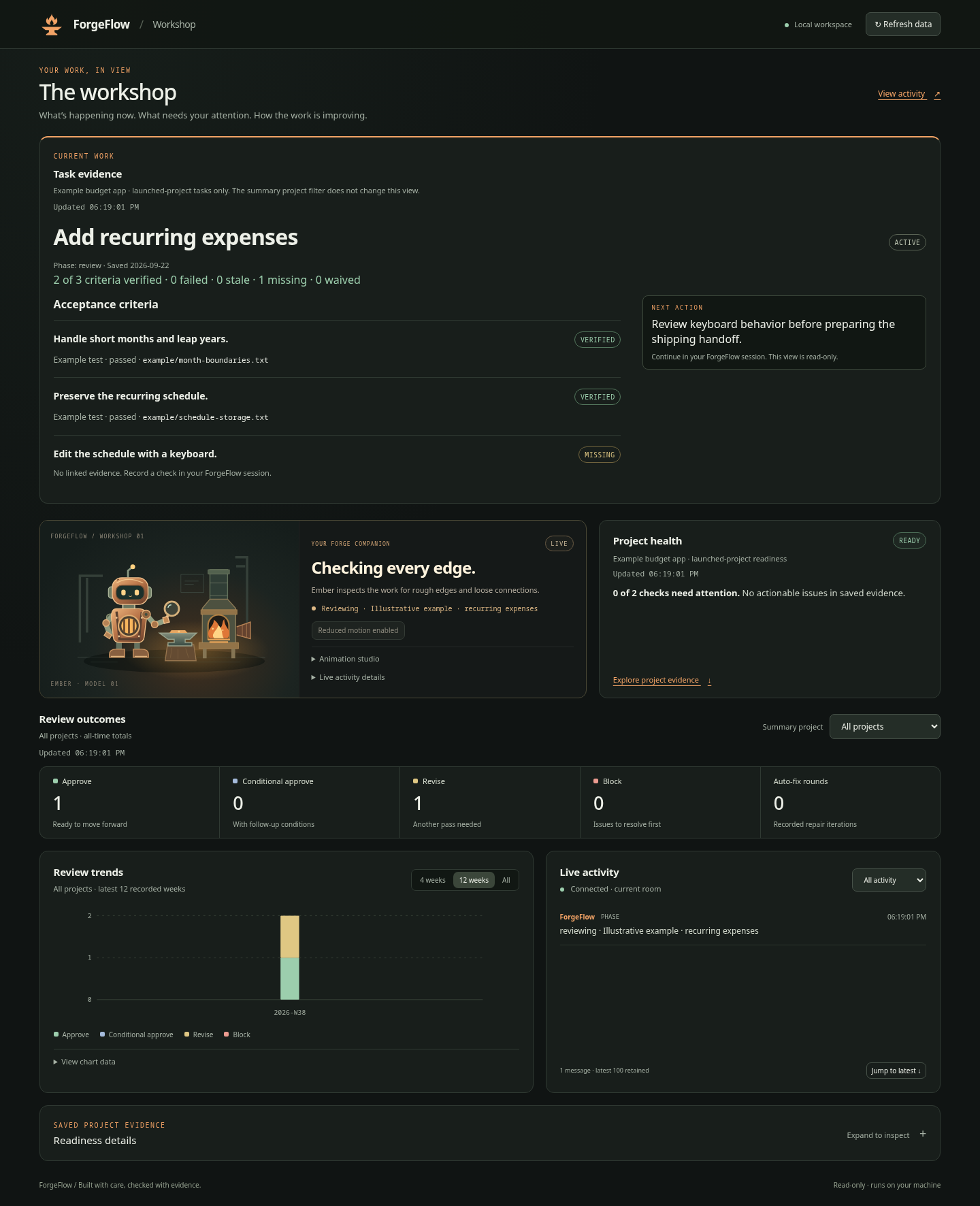
See reported activity, saved project readiness, and review outcomes in one local dashboard. Ember keeps you company along the way.

FORGEFLOW / LOCAL WORKSHOPFull-size screenshot ↗
ForgeFlow workshop dashboard with Ember reviewing, project health, recorded review outcomes, trends, and live activity.
Workshop screenshot with illustrative example data. This page does not display live project results.
VISIBILITY

Know what’s happening.

Follow reported phases and agent activity as the work moves forward.

CONTINUITY

Keep the useful context.

Carry implementation notes and project learnings into later work.

PERSPECTIVE

Inspect the evidence.

Explore recorded outcomes and readiness details, including gaps in the available evidence.

03 / MAKE SOMETHING WORTH SHIPPING

Start with one
real task.

Bring a working Claude Code or Codex setup and a project you want to improve. Start small, inspect the results, and expand when it helps.

OPEN SOURCE · MIT LICENSE

Your host.
Your project.
Your workshop.

Clone ForgeFlow, install into your coding host, then restart it. The guide walks through prerequisites, project setup, and the optional dashboard.

Read the visual guide ↗Full installation instructions ↗
01 / CLONE THE SOURCE
git clone https://github.com/BrandedTamarasu-glitch/ForgeFlow.git
cd ForgeFlow
node scripts/forgeflow/install-template.js --target codex --dry-run --json
node scripts/forgeflow/install-template.js --target codex

Inspect the dry-run preview before running the installer. Restart your host after installing.

03 / TRY A BOUNDED IMPROVEMENT

$consult Design a helpful empty state for the task list. Reuse the existing Create task action and include keyboard behavior.

KEEP EXPLORING

A little guidance.
A lot of possibility.