 ForgeFlow
ForgeFlow / Reference
Why ForgeFlow
ForgeFlow is a software delivery workshop for Claude Code and Codex. It helps an individual developer or a team move from an uncertain idea to an implementation brief, working changes, an evidence-backed review, and a clear shipping handoff.
What You Get
- Specialist judgment: agents cover backend craft, security, UX, coordination, architecture, and validation. Routing keeps the team proportional to the task.
- A repeatable workflow: enter at quick, consult, review, or an earlier discovery phase according to what the work needs.
- Useful project context: local notes, learnings, context packs, and budget guidance help later work start with relevant evidence. Current code and tests still decide correctness.
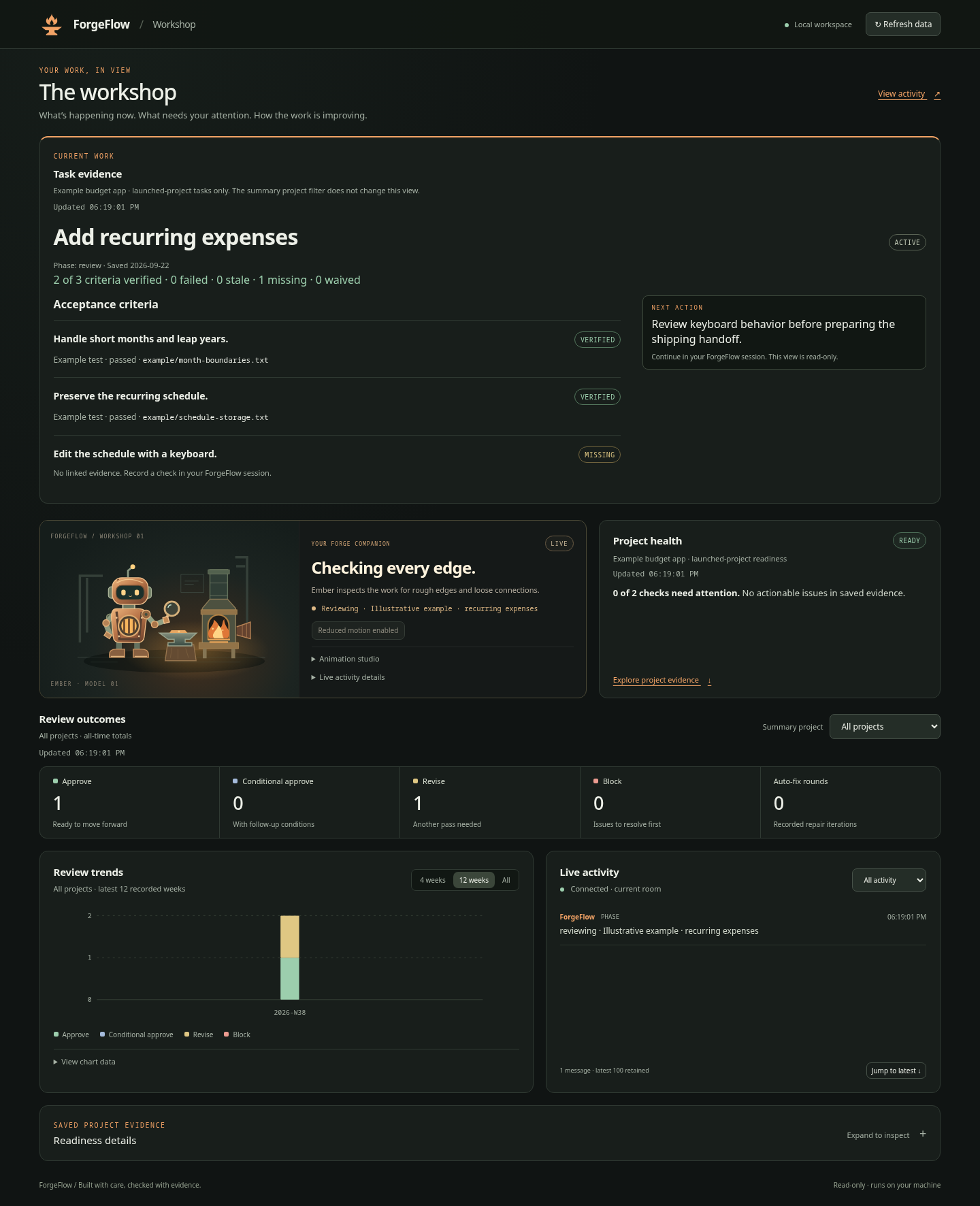
- A visible workshop: the local dashboard combines reported activity, project readiness, review outcomes, and trends. Ember tends the forge as phases change and settles into idle animation between tasks.
- Reviewable results: findings need evidence, validation is reported explicitly, and remote shipping actions require your instruction.
How It Fits Your Host
| Surface | Claude Code | Codex |
|---|---|---|
| Main workflows | Slash commands such as /consult and /review |
Skills such as $consult and $forge-review |
| Specialist agents | Claude agent definitions | Codex custom-agent definitions |
| Helpers and dashboard | Local runtime | Local runtime |
| Extended catalog | Larger slash-command reference | Installed skills plus explicitly invoked runtime helpers |
The hosts share the core delivery flow, but command names, settings, hooks, and available models differ. Start with Quick Start and use Workflow Commands as a reference when needed.
Try It On One Real Task
Pick something small enough to judge: a missing empty state, a reproducible bug, or a bounded refactor. Run consult, implement, review, and ship one step at a time. Inspect the brief, the resulting diff, and the validation evidence. Use the visual guide or PDF for the complete walkthrough.
The dashboard becomes more informative as actual work is recorded. A new installation can have no review history, no trends, and no optional benchmark evidence. Do not create sample outcomes to make those panels look complete.
Boundaries
ForgeFlow keeps its workflow artifacts locally by default. Your coding host and model provider still have their own data handling and network behavior; see Local Data and Privacy. A dashboard status or animation represents reported state, not independent proof of success. Multiple agents do not guarantee better results, and context savings estimates are not provider billing measurements.
For a structured comparison, Workflow Comparison explains how to compare actual reviews on the same change. Branch Trial and the Adoption Pack are optional tools for a broader evaluation.
Where It Came From
ForgeFlow grew from Review Squad's specialist-review approach. Review remains central, while the current product also supports planning, implementation, validation, project memory, and the local workshop. The historical 4.3.0 release brief records an earlier milestone; the README describes the current product.